Two weeks ago one of my prenatal ladies came to the clinic in labor. I had followed her pregnancy for several months, and during that time we’d developed a sense of trust --or so I thought.
When she arrived, she was 6 to 7 centimeters dilated with consistent contractions. Since it was her 5th child, I expected things to go quickly.
However, there were a few concerns.
Abdominally, her baby appeared to be breech. But when I tried to confirm vaginally, I had more questions than answers. The membranes wouldn’t allow for a clear diagnosis, and I was unwilling to rupture them to find out.
During her prenatals, she had never palpated breech before, so it came as a surprise. I questioned my suspicions though, saying that perhaps the heart-tones were high because the head was not engaged. Maybe what I felt in the fundus was just a really boney butt. So I noted it in her charted and waited.
Time would tell.
I re-examined her 6 hours later and she had not progressed at all. Moreover, the presenting parts were still unengaged despite increasingly effective contractions. This worried me.
Even though I had oxytocin at my disposal, and theoretically I could rupture her membranes, I hesitated to push things along. I could not rationalize the risks.
With the baby still unengaged, such actions could lead to cord compression... or worse. Cord prolapse. Maybe we just needed more time.
So I waited... and prayed.
Another 4 hours went by and she got more and more active. Outwardly, her contractions indicated birth was close and I considered doing another vaginal exam to reassure everyone. But I hesitated... what if there had been no progress? What if the head was still high? But if so, wouldn’t it be better to know?
This internal debate went on for sometime, but eventually, I caved in and did one.
The news wasn’t good; she had not budged at all. After close to 10 hours of stronger and longer contractions, she had dilated just one extra centimeter... but even that was iffy.
What was the hold up? Why wouldn’t the baby descend?
Over dinner, I casually mentioned her case to Dr. Tom, suggesting we might need a cesarean. I told him my hesitations and concerns, and together we agreed to stop her labor if she did not show significant progress within the next few hours. That way she could get some sleep and her family could start preparing money for a transport.
But an hour later her water broke.
I was pleased that things had progressed to this point, but did not do another vaginal exam. I figured that as long as the heart tones were good and moving lower on her abdomen we were golden.
Looking back, I regret that choice. I regret it a lot.
An hour later my shift ended and Margaret took over. Since the water had broken, I figured she’d deliver shortly and didn’t think to tell Margaret my suspicions.
That too, I regret.
Exhausted from the long labor watch, I turned in early. But by 3 a.m. there was a knock at the door. Groggily, I asked what the problem was.
-- “Margaret says she needs your help,” our health worker said quietly.
-- “Is there a new labor?” I asked.
-- “No. Same woman.”
-- “I’ll be there in two minutes.”
While my body changed into scrubs, my brain struggled to connect the dots. I had assumed she’d delivered hours before.
I was wrong.
I arrived to find her pushing and got hopeful, but it didn’t last long. I quickly realized that Margaret had decided to break her waters a few hours before (apparently the first rupture sealed off again or hadn’t happened at all). However, when that didn’t bring the baby down, she augmented with oxytocin.
After she explained the various measures she’d taken to spur on her labor, she told me why she had called for help. “I just did a vaginal exam, Steph. She’s fully, but I’m not sure if it’s the baby’s foot or arm.”
I asked her a number of questions, probing here and there. Then I put on gloves. If she was presenting a shoulder or a hand, we couldn’t let her push. So I stopped the oxytocin and asked her to breathe through her contractions.
A quick exam told me a lot. I measured her to still be about 8 cm dilated. And although there seemed to be more than enough room for a baby, the fetal parts were high. With the membranes out of the way, I could feel a squishy butt and what appeared to be toes. But honestly, the baby was just too high to get a good read on it.
Only then did I tell Margaret my suspicions. As I related the subtle warning signs I had observed, she seemed irritated. Why hadn’t I told her this hours ago?
I apologized. There was no good excuse.... except I honestly thought she’d already delivered and my suspicions were groundless.
Once it was decided to transport her for a cesarean, we worked quickly to inform the family and stop her contractions. The baby was alive, but the variables in his heart-rate worried me.
Sunlight was just a few hours off, so Margaret worked with the family to get money prepared for a transport. And I went back to sleep.
Just before 7 a.m., there was another knock at the door. It was louder this time. I opened the door to find Margaret’s lips pressed thin with disappointment.
-- “Is everything okay, Margaret? Is the baby alive?” I asked with an urgency I couldn’t suppress.
-- “There’s another labor. She just arrived,” she started to explain. “The woman from last night... well, I don’t know what happened. I’m still figuring out the details...”
-- “What do you mean?” I asked in confusion. “Did her family get the money for a transport?”
-- “They got some money... but when they could not find it all, they brought in a TBA (traditional birth attendant) to deliver the baby....”
-- “They did WHAT?” My mind jolted awake instantly. What was she saying?
-- “I don’t have the whole story yet... all I know is I went to check on her a few minutes ago and a TBA was there... I’ll explain later.”
I thanked her, closed my door, and then took a deep breath. I couldn’t worry about that just now. I had another labor to take care of.
When I got to the clinic, the other mama was active. Although she was not one of my prenatal ladies, she had heard good things about the clinic and wanted to see for herself. The friend that brought her used to work for us. I was happy they trusted us enough to come.
She delivered an hour later on her knees.
The peacefulness of her birth stood in stark contrast to the turmoil in my heart. I kept having to force my thoughts back on the woman before me. I couldn’t stop thinking about what was happening in the next room.
My mind raced round and round. “What was happening in there? Was the baby already born? What did Margaret mean that a TBA had come to help? Were they transporting still?”
By the time my labor had delivered and we got things cleaned up, the clinic was bustling. A line of women waited patiently outside on benches. The day had begun.
I didn’t hear the full story until late that afternoon when Margaret and I had time to connect again. The story she told doused my heart with indignation, then set it on fire.
Picking up were she left off that morning, she explained, “The woman’s husband didn’t go for money. He went for a TBA. Apparently, she arrived around 4 or 5 this morning, and the clinic worker just let her in...”
-- “Our health worker didn’t stop her?” I asked incredulously.
-- “No. He couldn’t explain why... but he gave her gloves,” she paused a moment then went on, “As you know, when we left last night, her contractions were stalled and she was sleeping (because of the medicines we gave her), so I can’t figure out how she pushed.”
-- “Yeah... how could the TBA get her to push if she was so drugged?”
-- “I don’t know... I don’t know. All I know is that when I went to check on her this morning, the baby was dead and she was covered in blood.”
-- “What did the TBA do?”
-- “The health worker said she reached inside vaginally and tried to pull the baby out.”
-- “Why didn’t he stop her?” I demanded with more indignation in my voice than I intended.
-- “He did not say. I don’t know...” she continued defeatedly. “But when I found her she was still wearing the bloody gloves and was trying to deliver your labor as well...”
Since neither of us were there, it’s hard to know for sure. I’m left to my imagination as to what really happened. What I suspect is that her husband assumed we were just not good enough midwives to get the baby out. He figured another one would do better.
But instead of fixing the problem, this woman made things worse. By trying to force the baby out (which failed), she killed him.
I suspect some kind of cord compression combined with fundal pressure.
We had spent 20 hours laboring with her to avoid this very thing. We’d given her our best. We’d done everything to keep that baby alive. And yet it was all for naught.
Her baby died... and she still had to have a cesarean.
I’ve thought about her labor a lot over the past few weeks, playing the what-if game in my head. I’ve gone over it again and again but to no avail. I have, however, made a few cultural observations.
The Sudanese seem to believe that:
-- the death of the baby is an acceptable, although disappointing risk of birth.
-- cesareans are to be avoided at all costs (not always for financial reasons).
-- cesareans should only be done to save the mother’s life, if the baby lives then good.
-- women have little to no say in their health care choices.
Many other lessons can be extrapolated, of course. And if I had it to do all over again, I’d do it much differently.
Suffice it to say... I’ve learned many lessons --the greatest of which is trust.
Trust is essential.
Showing posts with label Transport. Show all posts
Showing posts with label Transport. Show all posts
Thursday, March 22, 2012


Thursday, February 23, 2012
Five Boys! Six Girls!
I’ve delivered 11 babies in the last 10 days. It felt busy, but it didn’t occur to me that I had been that busy until I counted. I can’t help but smile though, as I read their stories and remember.
 My Valentine’s day baby --a boy-- was born during staff devotions. I remember how quiet the clinic was for a change since everyone was in the meeting. What a delightful birth!
The next day, Ajer delivered in a grand total of 45 minutes! Both she and her son had fevers and required lots of care, but they recovered in time.
Later that night Adut also delivered in record breaking time, then walked home an hour later!
The following morning Amour arrived looking active. Even though she had never come for prenatals and lived in Juba, her family insisted she deliver with us since I had delivered her sister’s baby a few months ago.
 They also explained that Amour’s first baby had died during the delivery because the TBA had “strangled the baby” on the way out. They did not want that to happen again. Why a TBA might do such a thing... I cannot say. But I was glad when she delivered without any complications a little while later.
The next birth was a few days later. Although only six months along, Adhar went into labor after contracting a viral infection. Her contractions had kept her awake the night before, but she did not think it was labor since “her months were not finished”.
Only when her water broke bringing forth more blood than amniotic fluid, did she come for help. But by then, there was little we could do. Her precious boy lived only a few minutes. He was just too small.
Later that night, Anhiem came in fully dilated with twins. My helper and I had just enough time to set up the room, when her little girl was born. The first twin weighed only 1.5 kg (or 3.3 lbs) and was small even for her gestational age (SGA) of 34 weeks.
However, her second twin did not want to come. Five minutes turned into ten, and the twin seemed no closer to coming. The heart tones were in the right position for the breech presentation, and when I reached in to check, I felt a knee.
Or so I thought.
After 15 minutes of pushing, we could no longer find heart tones and I called for back up. Margaret came and agreed that the baby must be dead.... but how? Why?
She redid the vaginal exam and pulled out and arm.
An arm!
Then it all made sense. The baby was not breech but transverse. The leg was an arm. There must have been some kind of cord compression... or prolapse. And the baby died.
We ended up transporting her to Wau for a cesarean, and she got her surgery the following morning. My heart is broken over this loss. Honestly, I can’t stop thinking about it.
 The next morning, another boy was born just before church! His mom arrived fully and pushed him out within minutes.
However the following birth was not so lucky.
Nyankiir arrived at 9 cm but stayed there for 4 1/2 hours. The head descended but much slower than seemed normal for a G7 (aka woman expecting her 7th child). Since four of her previous babies died during the birth, I confess I got a bit nervous. What if she needed a cesarean? What if this baby was too big for her pelvis?
 So we prayed, encouraged, did exercises, and then prayed some more. Eventually her girl made her debut though; she was born with both a nuchal hand and a tight nuchal cord. What an honor to be a part of her birth! (Kerri also wrote about her birth on her blog.)
What else? What else... ? Okay. Right.
So last night I was called again by the guard to come quickly. I arrived to find Veronica sweating large beads of sweat, and the look she gave me meant business.
 Remarkably she was able to hold off pushing until the room was readied. But then two minutes later her girl was born!
The laughter in the room when her friends arrived was priceless. Their happy chatter and excitement filled the room with joy, making the night feel like day. She too ended up walking home within an hour of so of birth. Remarkable.
 Then today there were two more births. Atong delivered at noon after laboring all night at home. Her baby was small but healthy. And just as I was getting ready to transfer her to the observation room, Rebecca arrived.
 I was surprised to learn that Rebecca wanted to deliver with us even though she’d never delivered any of her babies at a clinic... nor had she ever come for prenatal care. I didn’t have much time to question her about it though... as she started pushing almost as soon as she arrived.
Her little girl was born 5 minutes later!
Please pray for these moms and babies. Pray for health! Pray for salvation! Pray for healing! And ... pray for me. I think we are heading back into another busy season. Thanks.
 My Valentine’s day baby --a boy-- was born during staff devotions. I remember how quiet the clinic was for a change since everyone was in the meeting. What a delightful birth!
 The next day, Ajer delivered in a grand total of 45 minutes! Both she and her son had fevers and required lots of care, but they recovered in time.
Later that night Adut also delivered in record breaking time, then walked home an hour later!
The following morning Amour arrived looking active. Even though she had never come for prenatals and lived in Juba, her family insisted she deliver with us since I had delivered her sister’s baby a few months ago.
 They also explained that Amour’s first baby had died during the delivery because the TBA had “strangled the baby” on the way out. They did not want that to happen again. Why a TBA might do such a thing... I cannot say. But I was glad when she delivered without any complications a little while later.
The next birth was a few days later. Although only six months along, Adhar went into labor after contracting a viral infection. Her contractions had kept her awake the night before, but she did not think it was labor since “her months were not finished”.
Only when her water broke bringing forth more blood than amniotic fluid, did she come for help. But by then, there was little we could do. Her precious boy lived only a few minutes. He was just too small.
Later that night, Anhiem came in fully dilated with twins. My helper and I had just enough time to set up the room, when her little girl was born. The first twin weighed only 1.5 kg (or 3.3 lbs) and was small even for her gestational age (SGA) of 34 weeks.
However, her second twin did not want to come. Five minutes turned into ten, and the twin seemed no closer to coming. The heart tones were in the right position for the breech presentation, and when I reached in to check, I felt a knee.
Or so I thought.
After 15 minutes of pushing, we could no longer find heart tones and I called for back up. Margaret came and agreed that the baby must be dead.... but how? Why?
She redid the vaginal exam and pulled out and arm.
An arm!
Then it all made sense. The baby was not breech but transverse. The leg was an arm. There must have been some kind of cord compression... or prolapse. And the baby died.
We ended up transporting her to Wau for a cesarean, and she got her surgery the following morning. My heart is broken over this loss. Honestly, I can’t stop thinking about it.
 The next morning, another boy was born just before church! His mom arrived fully and pushed him out within minutes.
However the following birth was not so lucky.
Nyankiir arrived at 9 cm but stayed there for 4 1/2 hours. The head descended but much slower than seemed normal for a G7 (aka woman expecting her 7th child). Since four of her previous babies died during the birth, I confess I got a bit nervous. What if she needed a cesarean? What if this baby was too big for her pelvis?
 So we prayed, encouraged, did exercises, and then prayed some more. Eventually her girl made her debut though; she was born with both a nuchal hand and a tight nuchal cord. What an honor to be a part of her birth! (Kerri also wrote about her birth on her blog.)
What else? What else... ? Okay. Right.
So last night I was called again by the guard to come quickly. I arrived to find Veronica sweating large beads of sweat, and the look she gave me meant business.
 Remarkably she was able to hold off pushing until the room was readied. But then two minutes later her girl was born!
 The laughter in the room when her friends arrived was priceless. Their happy chatter and excitement filled the room with joy, making the night feel like day. She too ended up walking home within an hour of so of birth. Remarkable.
 Then today there were two more births. Atong delivered at noon after laboring all night at home. Her baby was small but healthy. And just as I was getting ready to transfer her to the observation room, Rebecca arrived.
  I was surprised to learn that Rebecca wanted to deliver with us even though she’d never delivered any of her babies at a clinic... nor had she ever come for prenatal care. I didn’t have much time to question her about it though... as she started pushing almost as soon as she arrived.
 Her little girl was born 5 minutes later!
Please pray for these moms and babies. Pray for health! Pray for salvation! Pray for healing! And ... pray for me. I think we are heading back into another busy season. Thanks.
Sunday, February 19, 2012
Update: Transport

We saw Awut about a month and a half ago. You might remember that she was expecting her 10th baby and her labor was not going well. She had CPD and we ended up transporting her for a cesarean. (Her story here.)
Well, I’m happy to report she and her little girl are both doing famously. Her scar is healing nicely and she is determined NOT to have any more children!
I laughed with her about her decision while bouncing her bright-eyed babe in my arms.
It’s not every day we hear back from our transport patients. Too often we cannot follow up on what kind of care they received, or even if they lived. But when I do, I’m always overcome with gratitude at God’s abundant mercies to us.
They named their girl “surgery”. Yep, only in Sudan! Thank you for praying for them and for all of us here in Tonj. Your prayers make a huge difference. Thanks.
Sunday, February 12, 2012
Emergency.

Last Monday night a semi (yes, a semi!) drove up with patients in it. Thirteen to be exact.
Thirteen bleeding, broken, and seriously hurting men.
They said they had been racing down the road at top speeds when a front tire blew, sending them rolling.
And rolling. And rolling.
The worst case was a man with a dislocated jaw; all of his front teeth were gone, and he was having trouble breathing. Once stabilized, we transported him and a few others with worrisome head injuries and broken bones to Wau.
When the dust settled, bruised and bloodied men were strewn about everywhere on make-shift beds. Some snored loudly; others moaned for water.
It was intense.
Afterward, Dennis commented that this was the worst car accident we’d had to deal with to date.
That was true, until today.
Today as church ended, a few government officials asked to use our cars and ambulance. There had been an accident. They needed our help.
The reports said there were lots of injured, so some of the medical staff went to help. But it took over an hour for the first patients to trickle in.
The first batch had two expectant mothers, a three-year-old boy, and a semi-conscious man.
One of the mothers had bitten three-quarters of her tongue off and had a large gash on her forehead, exposing her skull. When she woke up in the clinic, disoriented and scared, she thrashed in confusion.
I asked for her name but she couldn’t speak; her bloody grunts were unintelligible. We tried to guess what she was saying, but gave up, figuring it’d come out in time.
When I asked how many months pregnant she was, her eyes flashed with the unspoken question, “Is my baby alright?” Immediately she started gesticulating wildly, then held up 6 fingers.
 “You’re six months pregnant?” I asked to confirm.
 She nodded slowly.
“Can you feel your baby moving?” I continued.
She grunted no, adding a slight hand shrug for emphasis.
She was the right size for six months. The baby could be easily palpated; but I couldn’t find the heart-tones.
Each time I asked her anything about the accident, she would shake her head in confusion. Finally it occurred to me that she’d missed it all. Only later, once her tongue was reattached did she explain: “I don’t know if my belly was hit. The first thing I remember was waking up here.”
The other pregnant woman didn’t wake up for over an hour. She was in shock, and needed massive fluids to stabilize her blood pressure. But once she came around, I was happy to inform her her baby was alive. Fortunately, she only sustained a small gash on her thigh.
The young boy had no visible wounds and appeared stable. He had suffered a blow to the head and we were watching him closely. But as the second wave of injured were carried in, we needed his bed and moved him outside for observation.
The next batch had a hip fracture which needed to be braced, two or three semi-conscious men with only minor injuries, and two severe cases.
The first case was a man in obvious shock. He labored for every breath, fluttering in and out of consciousness. Starting an IV on him was next to impossible, since he fought me every inch of the way. I had to stick him 5 times before I got it in. Dr. Mike suspected massive internal bleeding.
The other case had massive head injuries and needed intubation. We don’t have any laryngoscopes, so we made due with half a speculum. Dr. Mike got the tube in without much trouble and together we bagged him until his breathing stabilized.
 The third batch of patients came back with our missing medical staff (which was half of us), and we were able to start move IVs, get more medicines, and stabilize a few more patients.
 Our guard did a fairly good job at keeping the looky-loos out of the compound. But he didn’t stop them all. I constantly had to chase away random gawkers, even walking some of them out of the compound myself.
I felt like a broken record asking them repeatedly to leave. But if I didn’t they would literally stand between the doctors and the patients, trying to get the best view. What a nightmare!
We started prepping to send the worst cases to Wau once stable. The broken femur and the internal bleeding were high priority. They also insisted the young boy go, even though he looked fine. Dr. Tom kept saying, “I just don’t feel good about keeping him here.”
But as we waited for the patients to be loaded into the ambulance, he died suddenly, surprising us all. He just stopped breathing.
Around the same time, the man Dr. Mike had intubated also died. His injuries were just too severe.
Only then did I have time to ask what happened.
 I was told that two SUVs, carrying about a dozen passengers each, had a head-on collision when one SUV inexplicably swerved into the wrong lane. They were both moving at high speeds; the impact was catastrophic.
 Fourteen people died on the scene --five of which were trapped inside the wreckage.
Those that were not brought to us were taken to the hospital in Rumbek. We lost two within an hour. That gives us an estimated total of 16 dead, and another 15-20 wounded.
I don’t know how many were sent to Rumbek. But honestly, I’m surprised there were only two vehicles involved. How did so many people fit in just two SUVs?
I’m proud of how well the staff worked together, but I’m sad at how many we lost. Please pray for these families. Pray as the Lord leads. Thanks.
Post Script: After the ambulance dropped off the first batch in Wau, they came back for two more. The pregnant woman with the missing heart tones went back because that’s where she’s from. And one more of the ‘less injured’ developed signs of possible internal bleeding. So we sent him as well.
Tuesday, January 24, 2012
A Transport.

Last night, Judo, a 22 year primigravida was carried into the clinic by her family. Exhausted she fluttered in and out of sleep as I checked her vitals.
She is from the Luo tribe; and since no one else in her family could speak any Dinka, she pushed past her fatigue to explain her long and difficult labor herself.
Her contractions had started two days before. Everything looked good until her water broke and she started pushing. She pushed and pushed for over six hours, but her baby would not come. Eventually her contractions just faded away.
She had not had a contraction since dawn --roughly 16 hours earlier.
Gesturing toward the wrinkled woman at the foot of her bed, she explained “My grandmother was my midwife. She said she could see the baby’s head, but it went back inside.”
I looked back and forth from her grandmother’s worried face to her oblong belly while trying to process her words.
What? She was in labor? She didn’t look like she was in labor. Could they have been mistaken? Perhaps she had malaria-labor and just dreamed up the fact the head was poking out?
--Doubtful.
I needed more facts.
A quick vaginal exam explained everything. Not only was she fully dilated, but the presenting parts were at a +2 station. Her pelvic outlet seemed adequate despite her low pubic arch, but the real problem was the swelling.
It took me a long, breathless minute before I realized the squishy mass of swollen flesh was her baby’s head. It was so edematous I could not find any suture lines. None at all.
Not good.
All the signs pointed to deep transverse arrest due to cephalopelvic disproportion (or CPD).
She needed a cesarean.
The good news was an American surgeon just came on staff last week. The bad news was we are not ready to start doing cesareans yet.
After discussing her case with the rest of the staff, we decided to transport her to Wau instead of risking an ill prepared surgery.
When we explained the situation to her family, they didn’t hesitate. They quickly gathered the necessary funds and an hour later she was en route.
I’m happy to say that this was the fastest transport we have ever organized. Originally when I heard that she’d be transported, I assumed we’d have to wait until sun up like before. But I was wrong. Apparently, we have a new driver who can go at all hours of the day and night.
What a blessing!
Today I am genuinely grateful for cesareans, ambulances, and willing drivers. By now, Judo and her baby should be recovering from surgery. Pray that it was successful and that they heal quickly. Thanks.
And also pray for our new surgeon and the many families he will bless in the coming months. I’m told that he is doing a hernia repair today. Exciting!
More about him later.
Saturday, December 31, 2011
Last week of 2011...
My silence this week has stemmed from a fierce desire to stay sane despite a post-Christmas birthing spree.
Apparently, a large number of babies were dead-set determined on being born in 2011. Three of the labors were teenagers.
The first was only 15 years old, but she was strong and resilient. She awed me with her determination and trusting spirit. Although her labor was painfully long, she rallied at the end and pushed with all her might. When her baby girl was finally born the whole room sighed in relief. She was amazing!
The next teenager was the exact opposite. She argued with me, ignored my advice, and fought me at almost every turn. Despite her attitude, her mother and I got along smashingly. We understood it was the pain talking, and found ways to laugh about it. When her baby boy was finally born, we laughed even harder at his enormous eyes! Apparently it’s a family trait.
However, the third teenager to deliver brought much sorrow. She had only been in labor for 2 hours by the time she got to us, but she was already fully dilated. There was no way to prevent the birth.
Since we weren’t sure how premature she was, we prepared for the worst but held on to hope.
After the birth, her baby needed some initial help breathing, but her APGAR scores were good. We were hopeful she’d do well despite her 1.2 kgs.
Long story short, we had to resuscitate her three separate times and start intravenous fluids. Although her color was good while on oxygen, she couldn’t maintain her own breathing without it.
She quietly died 5 hours postpartum while we watched on and prayed.
Her young parents wept openly as I prayed for them. But by then, their family had gathered and was able to comfort them in their grief as well. They even comforted me. This might seem strange, but I’m grateful I had the opportunity to be a part of her life... if only for those few hours.
Thankfully the rest of the births were less complicated --but not by much.
This week I also had another severe hemorrhage. But fortunately I was on my guard after last week’s hemorrhage and I was able to control it much faster. Her birth was a blur to be honest as she arrived at 1 a.m. and delivered mid-REM cycle.
It was almost a full day before anyone thought to tell me that she was one of our translator’s wives! Thinking back, I thought it was strange that he’d showed up at 1 am for no apparent reason, but in my foggy, sleep-deprived brain it never occurred to me that it was because she was carrying his child!
Yes... I really am that slow. But it would have been easier to believe if someone had bothered to tell me he got married!
So let me be the first to say (for anyone who has been to Tonj and reads this blog) that Peter Malok got married --there is still an issue with cows of course-- but he’s married, has a beautiful wife, and now a delightful daughter!
Let’s see... what else happened this week?
Oh, I also had to transport a woman for CPD (cephalo-pelvic disproportion) after an unsuccessful trial of labor. She arrived before dawn in a frantic state, saying she had been pushing for hours at home.
This was her 10th pregnancy --but only 4 were living. The rest died during delivery or shortly afterward. Fortunately, we had enough time to diagnose her situation and ready the ambulance for transport at first light.
I’m happy to say she got to Wau and was taken to surgery almost immediately. Both of them are doing well, I’m told.
There were a few other straight-forward births this week with happy moms and healthy babes. But the most memorable of them was Arop’s birth.
I’ll end with her story.
Arop lives 3 hour away by foot. But after her first three babies died during delivery at home, she decided to see if we could help for this next one.
She was faithful to come for prenatal care and we watched her closely, encouraging her to deliver with us no matter what.
She took our advice and started walking to the clinic once she was confident her labor began. She arrived fully and delivered a precious little boy 40 minutes later. Her birth was delightful and remarkably simple.
Afterward as I watched her breastfeed for the first time in her life, I was overcome with joy. She has carried 4 babies to term; she has labored 4 separate times; but this was the first time she’s ever heard her child cry. This was the first time she’s ever held one to her breast!
What a delightful way to end a year!
Happy New Year!
Apparently, a large number of babies were dead-set determined on being born in 2011. Three of the labors were teenagers.
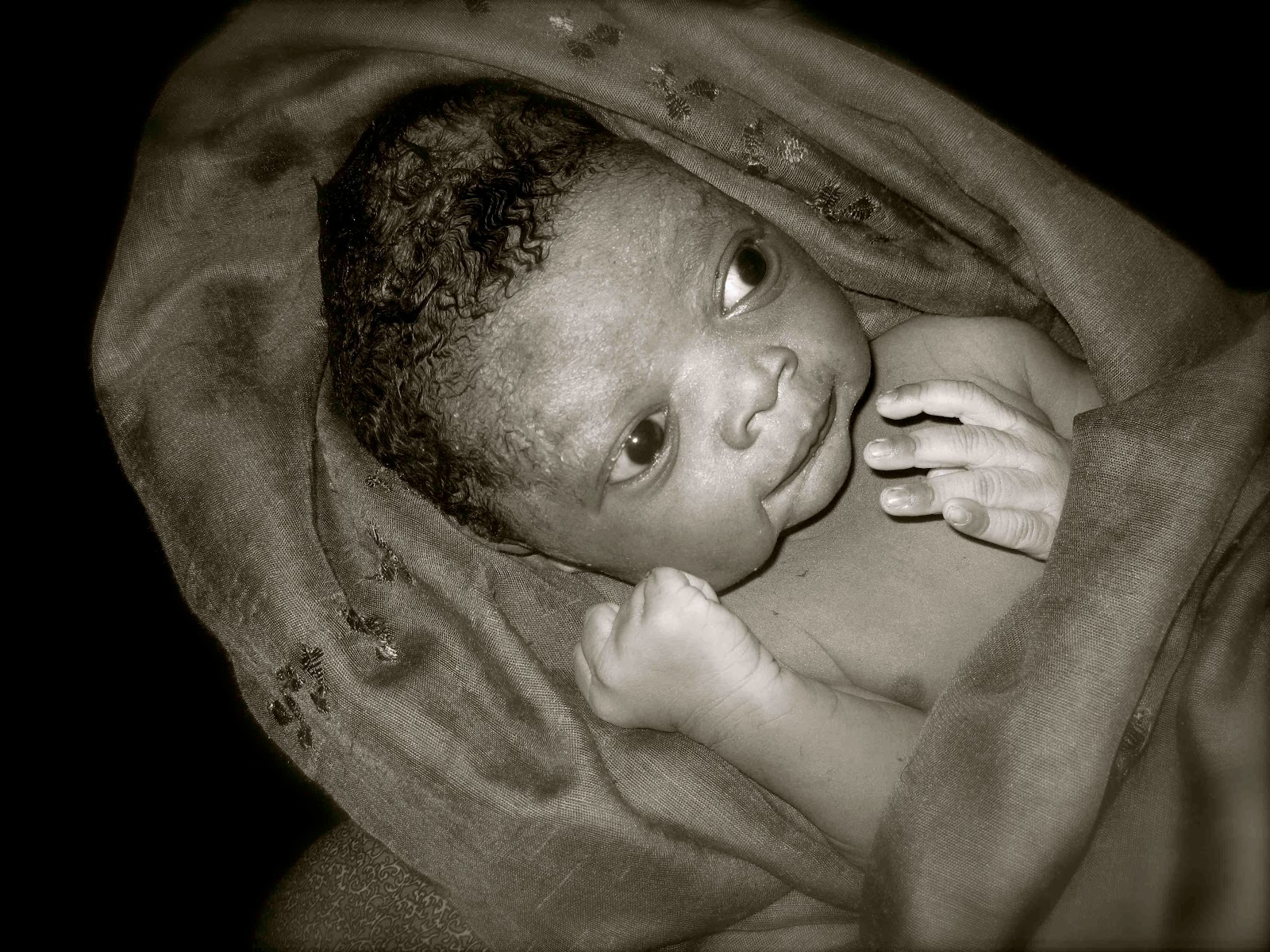
The first was only 15 years old, but she was strong and resilient. She awed me with her determination and trusting spirit. Although her labor was painfully long, she rallied at the end and pushed with all her might. When her baby girl was finally born the whole room sighed in relief. She was amazing!
 |
| Sweet baby born to, Elizabeth, the 15 year-old girl. |
 |
| What big eyes you have! |
Since we weren’t sure how premature she was, we prepared for the worst but held on to hope.
After the birth, her baby needed some initial help breathing, but her APGAR scores were good. We were hopeful she’d do well despite her 1.2 kgs.
Long story short, we had to resuscitate her three separate times and start intravenous fluids. Although her color was good while on oxygen, she couldn’t maintain her own breathing without it.
 |
| The preterm baby girl born this week. She lived only 5 hrs. |
Her young parents wept openly as I prayed for them. But by then, their family had gathered and was able to comfort them in their grief as well. They even comforted me. This might seem strange, but I’m grateful I had the opportunity to be a part of her life... if only for those few hours.
Thankfully the rest of the births were less complicated --but not by much.
This week I also had another severe hemorrhage. But fortunately I was on my guard after last week’s hemorrhage and I was able to control it much faster. Her birth was a blur to be honest as she arrived at 1 a.m. and delivered mid-REM cycle.
It was almost a full day before anyone thought to tell me that she was one of our translator’s wives! Thinking back, I thought it was strange that he’d showed up at 1 am for no apparent reason, but in my foggy, sleep-deprived brain it never occurred to me that it was because she was carrying his child!
Yes... I really am that slow. But it would have been easier to believe if someone had bothered to tell me he got married!
 |
| Peter Malok, his wife Akutet and baby girl. |
Let’s see... what else happened this week?
Oh, I also had to transport a woman for CPD (cephalo-pelvic disproportion) after an unsuccessful trial of labor. She arrived before dawn in a frantic state, saying she had been pushing for hours at home.
This was her 10th pregnancy --but only 4 were living. The rest died during delivery or shortly afterward. Fortunately, we had enough time to diagnose her situation and ready the ambulance for transport at first light.
 |
| Transporting for the CPD. |
There were a few other straight-forward births this week with happy moms and healthy babes. But the most memorable of them was Arop’s birth.
I’ll end with her story.
Arop lives 3 hour away by foot. But after her first three babies died during delivery at home, she decided to see if we could help for this next one.
She was faithful to come for prenatal care and we watched her closely, encouraging her to deliver with us no matter what.
She took our advice and started walking to the clinic once she was confident her labor began. She arrived fully and delivered a precious little boy 40 minutes later. Her birth was delightful and remarkably simple.
Afterward as I watched her breastfeed for the first time in her life, I was overcome with joy. She has carried 4 babies to term; she has labored 4 separate times; but this was the first time she’s ever heard her child cry. This was the first time she’s ever held one to her breast!
 |
| Arop breastfeeding her baby. What a smile! |
Happy New Year!
Saturday, September 24, 2011
Blood.
“Adut went to Wau and died,” Albino informed me.
"Adut?" I asked.
"The woman who needed the transfusion," he explained.
Albino is our compound manager and was the one who arranged for their transport.
He continued, “They were bringing her body back for the funeral, and their truck broke down. They want to use our ambulance again.”
“She died?” I asked incredulously.
“Yes. She died in Wau. They are stuck on the way back...”
“Did she get the transfusion?” I asked suspiciously. “Because had she gotten it... it’s unlikely she would have died.”
“I don’t know. I didn’t ask them,” he explained quietly.
“And what is going to become of the baby? Is there a wet-nurse in the family?” I persisted.
“I don’t know... I didn’t ask,” he repeated.
“Please ask them. I have to know...” I said, thinking to myself that I’d take the baby before they let her starve.
Mothers who die in or shortly after childbirth are trouble for the family. I’ve heard of more than one child left to die. I told this to Albino who nodded knowingly and told me he’d find out for sure.
That was two days ago.
Today Albino knocked on my door inviting me to go speak to the family. He remembered my offer to help if the family couldn’t (or wouldn’t) do it and wanted me to join him for a visit.
Eager to get the details of her care in Wau, I went with him. Sam, a Kenyan pastor on staff, joined us.
When we entered their bamboo gate, three men sat somberly beside a tukel and several sets of female eyes peered out at us from inside. Everyone was hiding from the mid-morning sun which was hotter than normal for the season.
The men didn’t rise to greet us, nor did they smile; the pall of mourning was heavy. They did shake our hands, however, and gesture to three empty plastic chairs. We sat down.
A long, respectful minute ticked by before Albino spoke. He told them we were sorry for her death and asked for details of their time in Wau. What had happened?
After a long discussion in Dinka, he turned to me to explain:
“She never got the blood,” he started, “They try to buy but there was no blood to buy. So, many got the test to see if they can give. They not have right blood.”
He paused to ask a few more questions, nodded as the husband explained, then continued:
“She had O+ blood. One man, he had same blood. But this man, he refuse to give. So she die.”
As he explained, my brain raced with this new information. I have O+ blood. I could have donated. Had I known, I would have given it happily. Why would that ‘man’ not give his blood? Why would he withhold what could so easily cure?
Albino then kindly asked them about the baby. I needed to know the child was well. In response, they brought her out of the tukel.
She was sleeping the deep sleep of baby-bliss. She knew nothing of the burial mound just 15 feet away --a mound topped with all of Adut’s worldly possessions. A worn out mattress. A green plastic basin. A cooking pot. Several dresses. A shovel.
As I looked from the child to the mound, I wondered what I’d leave behind if I were to die today. But I was quickly pulled from my reverie when Albino said my name.
“Stephanie,” he started, “they are giving the baby milk from market.”
“What kind of milk?” I asked. “Could I see it?”
They brought me a canister of baby formula and I asked them how they were giving it. What kind of water were they using? Were they giving it with a bottle or a cup? How many scoops were they using for the fluid?
Their answers were spot on; everything was being given correctly, and I was told that Adut’s mother (the grandmother) was now sole caregiver of the child.
As I looked at her thin, strong arms and grave but determined expression, I was comforted to see she was still young; she could be no more than 40 years old. There wasn’t a gray hair on her head, and only the slightest of crows-feet nestled in the corner of her eyes. The child would be well cared for and loved.
Albino suggested we pray before going, but I wasn’t ready. I wanted to teach them on how to prevent this from happening again. They agreed to hear me out and the newly formed crowd followed us to a shade tree outside their yard.
We sat in a circle and I prayed silently to myself before I began; I didn’t want to mess this up. I don’t remember all that I said, but it was a lot.
I explained the role of good antenatal care in preventing such sicknesses and the importance of delivering at clinics. They listened with rapt attention, eyes never leaving my face. I had a captive audience and was grateful for it. Perhaps this information will prevent any more women from dying in their family.
The women sat a bit further back but were equally attentive. They didn’t fidget or cough. They hung on every word.
--Lord, may all these women live!
After some time, I finished and Albino asked Sam to share the gospel. Sam spoke on the a verse in Isaiah that calls men grass (Is 40:6), reminding us all how fleeting and short life is. He encouraged them to place their faith in Jesus. Then Albino shared again.
I don’t know what he said but the crowd listened carefully.
Then the patriarch spoke. I never asked his name, but I don’t think I’ll ever forget his face. His dark blue jalibia stood out sharply against is cole-black skin. His piercing ebony eyes gazed fixedly on mine as he spoke. In them I saw pain and grief but no condescension.
His questions were honest --his pain real.
He spoke about the difficulty of being a patriarch, but he didn’t complain. Instead he explained how in the village when his daughter got sick, he had to take her to the witch-doctor first.
He lamented the social pressure he was under that forbid him from going to the hospital first. He added that in the village, when someone gets sick they must first find out if it’s a curse. So he took her to the witch-doctor.
Only when she didn’t improve did the witch-doctor allow them to bring her to the hospital. That’s when they came. But when they learned she needed new blood he finally understood. But by then it was too late. They weren’t able to get the blood.
“... had I known she just needed blood, I would have brought her earlier,” he explained, “But I was told she was cursed.”
My heart ached more and more with each sentence he spoke. Albino translated his words but the grief on his face needed no translation.
“Why is God letting all my children die?” he asked us. “It must be because He is far and does not know our troubles. He must not care...”
I listened carefully, thankful for his candor. Here was a man who really did want to understand. When he finished I asked for permission to answer his questions. Even though I spoke directly to him, everyone in the circle listened attentively.
Then I shared the gospel. I spoke about how his daughter was cursed, but not in the sense the witch-doctor suggested. She was cursed by sin. We all are. I explained that death was the consequence of sin, but that God had provided a way for forgiveness.
He listened carefully. Respectfully. They all did.
I gave them the clearest gospel message I could and we invited them to church. Afterward they thanked us for sharing this information with them. They had never heard these things before.
We prayed for them and left, shaking each one’s hand in respect.
As sad as her death is, I pray that it will be the start of new life for the rest of her family. Please pray with me that the seeds shared would find good soil and bring much fruit. Thanks.
Also pray for us to find a way to do blood transfusions. This is now the 3rd maternal mortality I know about that could have been cured with a simple transfusion.
"Adut?" I asked.
"The woman who needed the transfusion," he explained.
Albino is our compound manager and was the one who arranged for their transport.
He continued, “They were bringing her body back for the funeral, and their truck broke down. They want to use our ambulance again.”
“She died?” I asked incredulously.
“Yes. She died in Wau. They are stuck on the way back...”
“Did she get the transfusion?” I asked suspiciously. “Because had she gotten it... it’s unlikely she would have died.”
“I don’t know. I didn’t ask them,” he explained quietly.
“And what is going to become of the baby? Is there a wet-nurse in the family?” I persisted.
“I don’t know... I didn’t ask,” he repeated.
“Please ask them. I have to know...” I said, thinking to myself that I’d take the baby before they let her starve.
Mothers who die in or shortly after childbirth are trouble for the family. I’ve heard of more than one child left to die. I told this to Albino who nodded knowingly and told me he’d find out for sure.
That was two days ago.
Today Albino knocked on my door inviting me to go speak to the family. He remembered my offer to help if the family couldn’t (or wouldn’t) do it and wanted me to join him for a visit.
Eager to get the details of her care in Wau, I went with him. Sam, a Kenyan pastor on staff, joined us.
When we entered their bamboo gate, three men sat somberly beside a tukel and several sets of female eyes peered out at us from inside. Everyone was hiding from the mid-morning sun which was hotter than normal for the season.
The men didn’t rise to greet us, nor did they smile; the pall of mourning was heavy. They did shake our hands, however, and gesture to three empty plastic chairs. We sat down.
A long, respectful minute ticked by before Albino spoke. He told them we were sorry for her death and asked for details of their time in Wau. What had happened?
After a long discussion in Dinka, he turned to me to explain:
“She never got the blood,” he started, “They try to buy but there was no blood to buy. So, many got the test to see if they can give. They not have right blood.”
He paused to ask a few more questions, nodded as the husband explained, then continued:
“She had O+ blood. One man, he had same blood. But this man, he refuse to give. So she die.”
As he explained, my brain raced with this new information. I have O+ blood. I could have donated. Had I known, I would have given it happily. Why would that ‘man’ not give his blood? Why would he withhold what could so easily cure?
Albino then kindly asked them about the baby. I needed to know the child was well. In response, they brought her out of the tukel.
She was sleeping the deep sleep of baby-bliss. She knew nothing of the burial mound just 15 feet away --a mound topped with all of Adut’s worldly possessions. A worn out mattress. A green plastic basin. A cooking pot. Several dresses. A shovel.
As I looked from the child to the mound, I wondered what I’d leave behind if I were to die today. But I was quickly pulled from my reverie when Albino said my name.
“Stephanie,” he started, “they are giving the baby milk from market.”
“What kind of milk?” I asked. “Could I see it?”
They brought me a canister of baby formula and I asked them how they were giving it. What kind of water were they using? Were they giving it with a bottle or a cup? How many scoops were they using for the fluid?
Their answers were spot on; everything was being given correctly, and I was told that Adut’s mother (the grandmother) was now sole caregiver of the child.
As I looked at her thin, strong arms and grave but determined expression, I was comforted to see she was still young; she could be no more than 40 years old. There wasn’t a gray hair on her head, and only the slightest of crows-feet nestled in the corner of her eyes. The child would be well cared for and loved.
Albino suggested we pray before going, but I wasn’t ready. I wanted to teach them on how to prevent this from happening again. They agreed to hear me out and the newly formed crowd followed us to a shade tree outside their yard.
We sat in a circle and I prayed silently to myself before I began; I didn’t want to mess this up. I don’t remember all that I said, but it was a lot.
I explained the role of good antenatal care in preventing such sicknesses and the importance of delivering at clinics. They listened with rapt attention, eyes never leaving my face. I had a captive audience and was grateful for it. Perhaps this information will prevent any more women from dying in their family.
The women sat a bit further back but were equally attentive. They didn’t fidget or cough. They hung on every word.
--Lord, may all these women live!
After some time, I finished and Albino asked Sam to share the gospel. Sam spoke on the a verse in Isaiah that calls men grass (Is 40:6), reminding us all how fleeting and short life is. He encouraged them to place their faith in Jesus. Then Albino shared again.
I don’t know what he said but the crowd listened carefully.
Then the patriarch spoke. I never asked his name, but I don’t think I’ll ever forget his face. His dark blue jalibia stood out sharply against is cole-black skin. His piercing ebony eyes gazed fixedly on mine as he spoke. In them I saw pain and grief but no condescension.
His questions were honest --his pain real.
He spoke about the difficulty of being a patriarch, but he didn’t complain. Instead he explained how in the village when his daughter got sick, he had to take her to the witch-doctor first.
He lamented the social pressure he was under that forbid him from going to the hospital first. He added that in the village, when someone gets sick they must first find out if it’s a curse. So he took her to the witch-doctor.
Only when she didn’t improve did the witch-doctor allow them to bring her to the hospital. That’s when they came. But when they learned she needed new blood he finally understood. But by then it was too late. They weren’t able to get the blood.
“... had I known she just needed blood, I would have brought her earlier,” he explained, “But I was told she was cursed.”
My heart ached more and more with each sentence he spoke. Albino translated his words but the grief on his face needed no translation.
“Why is God letting all my children die?” he asked us. “It must be because He is far and does not know our troubles. He must not care...”
I listened carefully, thankful for his candor. Here was a man who really did want to understand. When he finished I asked for permission to answer his questions. Even though I spoke directly to him, everyone in the circle listened attentively.
Then I shared the gospel. I spoke about how his daughter was cursed, but not in the sense the witch-doctor suggested. She was cursed by sin. We all are. I explained that death was the consequence of sin, but that God had provided a way for forgiveness.
He listened carefully. Respectfully. They all did.
I gave them the clearest gospel message I could and we invited them to church. Afterward they thanked us for sharing this information with them. They had never heard these things before.
We prayed for them and left, shaking each one’s hand in respect.
As sad as her death is, I pray that it will be the start of new life for the rest of her family. Please pray with me that the seeds shared would find good soil and bring much fruit. Thanks.
Also pray for us to find a way to do blood transfusions. This is now the 3rd maternal mortality I know about that could have been cured with a simple transfusion.
Saturday, January 15, 2011
Waiting to die...
 |
| Preparing the vehicle to transport her. |
Monica was a regular prenatal patient. Each time she came, I stressed the importance of delivering with us. She also knew not to push longer than two hours at home for I taught it many times. But as a 19 year old Dinka girl expecting her first child, she was at the mercy of her family when it came to how she’d deliver... not her midwife.
When her labor started, her family chose to keep her at home calling for a TBA (Traditional Birth Attendant) to watch her through the night. By morning, even though she was fully dilated, the TBA wasn’t able to get the baby to come down. She pushed for hours causing the baby’s head to swell as well as her labia. The TBA did all she could but eventually gave up.
Precious time lost.
But instead of coming to us next, they gathered their money and took her to a witch doctor, where (I’m told) he massaged herbs on her belly and proclaimed that ‘Now, the knots were untied and the baby could be born.’ Realizing he had nothing left to offer, they finally brought her to us.
More time lost.
When she arrived, I estimated she had been fully dilated for at least 6 hours, possibly longer. Her contractions were still strong but there was absolutely no progress. She lay exhausted, writhing in silent pain as her family explained all they had done.
As I did a vaginal exam, I knew immediately she required a cesarean. There were too many signs of obstructed labor. This couldn’t be fixed by binding her belly. This wouldn’t progress if I stretched her and forced her to push. This appeared to be a case of deep transverse arrest (when the fetal head gets stuck in the mid-pelvis, restricting the mechanisms of labor). So I told her family she needed a cesarean. They didn’t seem surprised.
Fortunately, both Monica and child where doing fairly well. All we had to do was get her to Wau and they could be saved. There was just one catch, night was falling. Buses don’t travel at night. However, even if it were broad daylight, they’d be out of luck. With all the voting this week, the buses were booked solid. Even if the family paid twice the fare, there were no seats available. So I went to Sabet and asked if we could drive her.
He was happy to comply but we had to find our diver first. It’s dangerous to drive at night but sometimes if he is in the right mood, and you ask him nicely he will take that risk. We sent people to find him.
More waiting.
The family paced the floor while she writhed in pain. I went back to Sabet an hour later asking if we found our driver. He explained he couldn’t locate him and that we’d have to wait until morning. But even then, they wouldn’t leave at first light since the truck would need to be fueled first.
Meanwhile, the family told me they had arranged for a motor bike to take her home. What? I was confused. “How will she get to Wau if they went home?” I asked naively. Only then did it occur to me that they were giving me an out. They wanted to take her home to die.
The last time I had this conversation I kept telling the family that the patient (a multigravida with IUFD and potential placenta abruptio. Her story here. And here.) needed to get to Wau or she’d die any minute, thinking that pressuring them would get her there faster. It didn’t. It just made them insist she go home and die there instead. The family gave up because I painted such a dark picture.
So this time, I played my cards differently. I reminded them that Sabet had promised transportation at sun-up. All they had to do was get through the night and we’d drive them to Wau. I explained that both she and the baby were alive and they shouldn’t give up hope.
They were glad for the news. But it meant more waiting.
My stomach churned as I considered how long she’d have to endure. Already, she had suffered so much. I couldn’t help but marvel at how she handled the pain. But her silence wasn’t courageous resolve for her eyes betrayed her. They darted from face to face in panic. Fear had it’s grip on her. So I prayed.
I prayed she would be able to handle the pain, that the contractions would stop, or that miraculously the baby would be born. I prayed that if not, she’d make it to Wau and both would be saved. I entrusted her to God and went to sleep. The on-duty health worker would check on her in the night and alert me if there was a problem.
Tossing and turning all night, I got up early to check on her. I needed to be reassured. I arrived as the health worker was unsuccessfully trying to find heart tones. It was apparent Monica hadn’t slept at all.
I shooed away the onlookers as I searched for heart tones myself. Nothing. Her abdomen was taut and tender to the touch. How long had she been like this? The health worker explained he never checked on her in the night. What? I wanted to scream it but didn’t want to cause a scene.
“What do you mean you never checked on her? You were suppose to check her every two hours. I left very clear instructions.” He stammered something about not having been told, refusing to look me in the eye.
I was kicking myself for not waking the guard to let me out of the compound that night to check on her. I should have been more persistent. I shouldn’t have trusted our health worker with something so important. I was mad at him... myself... and the situation.
She was in shock. Her blood pressure was bottoming out. It wasn’t good. On top of it all, her baby was dead. I couldn’t find a heartbeat anywhere. I called for Dennis to help me get an IV started as her veins were collapsed. He got it on the third try. Then I went to wake Sabet.
I explained that the baby had died in the night and the laboring mom couldn’t wait any longer. She was in shock. We needed to go now or she’d be dead too. He immediately got on it, saying he didn’t realized she was at such a risk. An hour later they were on the road.
In my head I imagined they’d drive up to the hospital, rush her through the doors and take her directly to surgery. She’d be saved. But I was wrong.
Our driver returned in good spirits saying she got ‘a picture taken of her baby on the inside’ (ultrasound?) and it was still alive. (Really the baby was alive? How?) He added that the ‘doctor lady’ said Monica would be observed for another 8 hours. If she didn’t deliver in that time then they’d do a c-section that night. (What? She is being made to wait another 8 hours! $#@%$#!) I wanted to scream.
I bit my tongue instead and smiled as he gave me this ‘great news’. My gratitude was genuine. I was thankful he was willing to go, for Sabet’s generosity in sending the vehicle, for the family’s continued hope. I trusted that the doctors in Wau knew what they were doing. I trusted God with her life. It didn’t make sense to wait. She had waited long enough but it wasn’t up to me. (By the time she arrived in Wau, she was fully for over 24 hour.)
So I waited and prayed. More time lost.
The next day I learned that she got the cesarean after failing to progress in Wau. She waited 7 hours before they took her in. The baby was born dead (not a surprise) and an hour post-op, she joined him. I don’t know why.
I think it was all the waiting.
Her death surprised me -- not because dying in childbirth isn’t possible but because it was completely avoidable. I know it’s foolish to play the ‘what if’ game but I can’t help it.
What if she came to the clinic earlier?
What if they hadn’t wasted time pushing so long?
What if they bypassed the witch doctor?
What if they arrived before sunset?
What if our driver was found and took her to Wau that night?
What if the hospital rushed her to surgery immediately?
What if... What if....
Friday, December 31, 2010
Two Broken Legs and a Baby.

Last night I was called to the clinic to help with an emergency. Two women were in critical condition after being hit by a truck. To get to them, I had to walk through a dozen somber looking men gathered on the clinic porch. They pressed in to see but our staff barricaded the doors; the doctors needed space to work.
My patient was named Adong. She looked to be in her twenties and had a severe fracture of her left femur; it lay unnaturally swollen and twisted. When I lifted it back in place, I could see where her bones were no longer connected. It was a clean break -- No doubt a painful one.
While irrigating a deep gash on her foot and removing mud and sand from various wounds, I was able to piece together her story. She and her sister-wife, were walking alongside a road when a land cruiser hit them, sending them flying. The driver stopped, abandoned the vehicle and ran for his life. They knew both the driver and the vehicle well. There was no doubt who was responsible.
Only then did she ask me if her baby was okay. What? She’s pregnant? I made her repeat herself. She explained she was five months along.
-- “My stomach hurts a lot. Is my baby okay?” She groaned in delirium as I palpated her belly. “It hurts everywhere.” I could feel the well formed baby beneath her skin, perhaps she was more than five months.
-- “Can you feel your baby moving?” I asked. But she seemed not to hear... or understand. Instead she repeated how she was in pain and wanted to turn on her side.
-- “Your leg can’t be moved right now. Why do you want to turn?”
-- “I have to turn because my baby is uncomfortable in this position. I have to lie on my side.”
-- “Please don’t move. I’ll check on your baby. Just don’t move.”
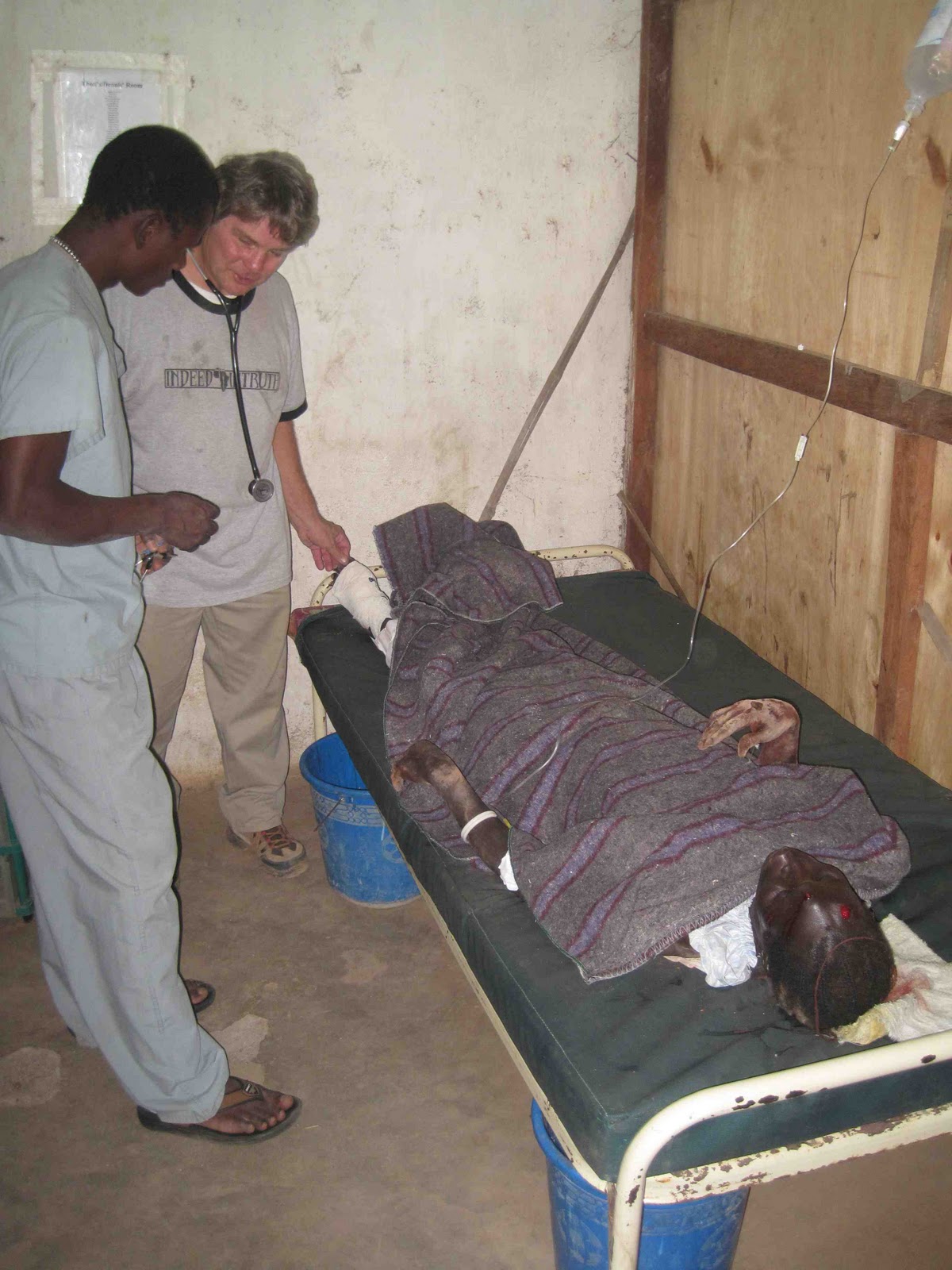 |
| Adong with Dr. Tom |
-- “Adong, your baby is fine.” I reassured her. “He’s fine. Meth Apoul. He’s doing well. ”
The room sighed in relief with me... but she moaned. The pain was intense. I took her hand and prayed. I couldn’t thank Him enough that they were all alive. It could have been much worse. I then went to pray with Amer, her sister-wife in the next room. Amer sustained a fractured right leg and several facial lacerations. She was stable and despite the blinding pain, would live.
The crowds continued to come and go. Among those pressing to get into the clinic were newspaper reporters and police investigators. Everything had to be documented. The man who hit them was a foreigner, an Ugandan. He worked for a Christian relief organization. Worse still, he attends our church and once worked with our ministry. We know him well.
As the reality of this news became clear, each face grew heavy in question marks and concern. Would their family retaliate? Would he be killed? Would he flee to Uganda? How will any good come of this? Answers would come in time. So we turned in for the night.
 |
| Amer after being stabilized. |
This morning’s light brought more officials, commissioners and looky-loos. It took some time for the women to be moved to our vehicle. But by mid-morning all was arranged and they left for Wau.
I also learned that the driver was arrested (mostly for his protection) and is now being held in custody. Since no one died, his life is not in jeopardy but he will have to pay several fines.
Please pray with me Romans 8:28 for our Ugandan brother. Pray for wisdom, peace, protection and grace. Pray for these women and their families; healing, life, forgiveness and mercy. May this little baby grow healthy and strong. Amen.
Wednesday, November 24, 2010
6 days and 6 nights.
 |
| Transporting her with our truck. Family looking on. |
Of course... I couldn’t be sure until I did a vaginal exam. But she refused one and said she was going home to deliver. huh? I encouraged her to stay. Why come all this way, if you didn’t want my help? But she grabbed her things and rushed home.
This is fairly common here. Often, women come to ‘verify’ with me if labor has started and then go home to give birth. I don’t stop them but it breaks my heart. I figure there is something socially I’m still not clueing in on... perhaps I’ll understand better in time.
Well... this morning Nyibol came back still in labor!
She explained that she’d now been in labor 6 days. Her water broke 3 days ago (after seeing me Monday morning) and it was originally clear but then became brown. Her baby was alive (Thank God!) but she was exhausted. She hadn’t eaten in three days. Nor had she urinated.
As a result she had a painfully distended bladder which was likely one of the factors in her lack of labor progress. We removed 800-1000 cc of urine with a straight catheter and did a vaginal exam. She was fully but the baby’s head was swollen (3 cm caput). Her pelvis seemed adequate but the contractions had stopped last night.
As we started the IV fluids to induce her, she explained that her family had done fundal pressure and she had been pushing for days. But the oxytocin wasn’t working. We turned up the drip as fast as was safe but it didn’t produced even a twitch of a contraction.
There was nothing left for us to do but transport. It was too late. I truly believe she could have delivered vaginally if she had stayed at the clinic. Perhaps not.
The family was able to find money for a cesarean and the ministry truck was free so we took her to Wau. This afternoon she was taken into surgery.
So rejoice with me. This is a victory. A life saved -- two even. I’m just sorry it came at such a price.
Imagine, 6 days of pain... 6 nights of sleeplessness!
Update~
So I got some of my facts wrong. She got to Wau this afternoon but... when they checked her in, they discovered that her baby had died on the way. So she didn't get the cesarean right away, they have waited until this evening to do it. She is likely on her way to surgery right now. Please pray for her, her family and this precious child lost.
Sunday, November 7, 2010
... to save a life.
A young woman came in this morning because she was 5 months pregnant and miscarrying. She had lots of bleeding and abdominal pain since last night. When I saw the amount of bleeding, I assumed the child was already dead. But he wasn't.
I could hear his heart ticking away at lightening speed. Tic-tic-tic-tic-tic-tic-tic-tic-tic-tic-tic! The rate was high of course (160-170s) but he was alive. She told me her water broke a full week before. It didn't look good. But he was still alive.
I told her family that she needed to get help at Wau, that we didn't have the means to help her. But her mother said... "I understand we should go to Wau. But it's better if the pregnancy ends now." Only then did it occur to me that perhaps this woman had tried to abort this child. I tried to ask if anything had been put inside the woman to stop the pregnancy? Did anyone give her special herbs to drink? They assured me that they hadn't. I want to believe them. Most of me does.
Understanding that she needed the care in Wau, the family rallied and found money. But before she left, I had to warn her not to let the bus driver know she was sick. In the past, the drivers refused to take sick patients or charged them 300 pounds (a months salary) to take them. Extortion.
When I explained this to the women they grew somber, immediately understanding the situation. It broke my heart to have to warn her not to groan in pain on the bus for fear they'd kick her off. But I did. I told them she'd have to change her clothes and hide the blood as well. They complied.
It's wrong to lie. It's wrong to deceive. And I told them so. But I think it's even more wrong to charge 100 times the bus fare to sick patients. I look forward to having an ambulance. I really do.
Pray she gets on that bus and is able to get the care she desperately needs. Thanks.
I could hear his heart ticking away at lightening speed. Tic-tic-tic-tic-tic-tic-tic-tic-tic-tic-tic! The rate was high of course (160-170s) but he was alive. She told me her water broke a full week before. It didn't look good. But he was still alive.
I told her family that she needed to get help at Wau, that we didn't have the means to help her. But her mother said... "I understand we should go to Wau. But it's better if the pregnancy ends now." Only then did it occur to me that perhaps this woman had tried to abort this child. I tried to ask if anything had been put inside the woman to stop the pregnancy? Did anyone give her special herbs to drink? They assured me that they hadn't. I want to believe them. Most of me does.
Understanding that she needed the care in Wau, the family rallied and found money. But before she left, I had to warn her not to let the bus driver know she was sick. In the past, the drivers refused to take sick patients or charged them 300 pounds (a months salary) to take them. Extortion.
When I explained this to the women they grew somber, immediately understanding the situation. It broke my heart to have to warn her not to groan in pain on the bus for fear they'd kick her off. But I did. I told them she'd have to change her clothes and hide the blood as well. They complied.
It's wrong to lie. It's wrong to deceive. And I told them so. But I think it's even more wrong to charge 100 times the bus fare to sick patients. I look forward to having an ambulance. I really do.
Pray she gets on that bus and is able to get the care she desperately needs. Thanks.
Sunday, August 15, 2010
Reasonable Tradition?
I don't know how to begin my story, so I’ll start in the middle. Earlier I wrote how a woman was in “labor” with a stillbirth after severe bleeding for a day and a half. (read her story below: VASA PREVIA.)
You prayed. I prayed. Here’s what happened next.
Well, She had been at our clinic all morning, stable and ready to go to Wau once the family got the money. They found the money but then needed to get bus tickets or a car. They went to look for it and some more money. I waited patiently for the family to return with the good news... and take her to Wau. They didn't come. Then I waited a little less patiently. I even got loud.
What's going on? Don’t you know she's sick? Why aren't you doing anything?
They just looked around confused. She looked fine to them... what's the big deal? So what if she’s barely able to sit up and urinating blood so dark it’s purple? She doesn't look that bad! I wanted to beat something... someone. They had given up.
But part of me doesn't blame them. They tried to raise funds and got enough to get her surgery but when they went to buy a bus ticket to Wau, the driver extorted them for more.
A ticket that should cost 30 pounds would cost THEM 150 a person because she was desperate. Yes. You read that right. They'd have to pay five times as much... double even... because a care taker must go as well. Pay 300 pounds and we'll take ya! I understand why they gave up. Three hundred pounds is more than most people make in a month.
But I don't understand why the bus driver would do that. Here a woman's life is in the balance. They saw only dollar signs! AAAAhhhhhhhgGGGG! I was so angry I could have spit!
Fine so the bus option was out. But the good news was they had enough money for the hospital stay. We were driving to Wau the following morning and would take them with us. All she had to do was stay alive through the night. I was prepared to do everything possible to make that happen.
It’s at this point that I decided to induce her. Perhaps if we could just deliver the baby, the bleeding could be controlled. Perhaps, by God’s grace, she wouldn’t have any further bleeding. It was a risk but one I was willing to take.
Just as her contractions picked up, they started talking about taking her home. What? But if she goes home, she might hemorrhage even more and a blood clotting disorder can happen. (This is called DIC -- disseminated intravascular coagulation). If it happens, she'll not be able to clot her own blood and bleed out quickly. It's dangerous. It’s better she deliver at the clinic where we have life saving measures available. But the family kept insisting. They wanted to take her home.
I begged them to stay until Sabet came back from his trip. He had been away all day with the car. (That's why we couldn't take them to Wau ourselves). He was due home at 5pm. They agreed to stay... but were anxious.
However, as God would have it, Sabet got delayed. And with each passing hour, they insisted louder. I told them they were free to go whenever they wanted. I couldn’t make them stay. But I kept praying they’d stay. I felt like a prison guard keeping her hostage. She wanted to go. Why? I wondered. To die? Eventually after waiting 3 additional hours, I unhooked her IVs (she had two) and let them carry her away.
As she was unable to walk, we drove them home. And as they loaded in the car, her brothers assured me they'd be back tomorrow morning to go into Wau with our truck. Just then Sabet arrived. But it was too late to convince them to stay.
They drove off and my stomach sank. Ten hours I kept her stable and alive. The induction was working and she was already 4-5 cm dilated. *When I did the last vaginal exam, I felt only placenta. My best guess is placenta previa but one that was completely detached. (I say this because she had absolutely no pain.)
So to answer all your questions, I don't know if she lived. All I know is she left our clinic alive. We called numerous times the following day but no one answered. That morning on the way into Wau, we drove by their house but it was empty. The locals I asked all think she was taken to the witch doctor. I don't know if she lived. I wish I knew. It eats me alive to think they chose to take her home than spend the night at the clinic. But that is the case.
I asked Sabet why they'd insist on taking her home when we could keep her stable and transport her to the hospital the following day. He explained that the Bongo tribe (of which she is a part) do a number of rituals on a dying person. It's VERY important for them to make sure all the rituals are observed. They would not have had the chance to do them at the clinic.
So in the end, tradition won out over reason. And in this case, it may have cost a life.
*(midwife disclaimer): I know I'm not suppose to do a vaginal exam when there is bleeding. It was a judgment call. Once I knew there wasn't a chance I was going to get her to the hospital, I needed to know what I was dealing with. Please understand. And if necessary, forgive.
You prayed. I prayed. Here’s what happened next.
Well, She had been at our clinic all morning, stable and ready to go to Wau once the family got the money. They found the money but then needed to get bus tickets or a car. They went to look for it and some more money. I waited patiently for the family to return with the good news... and take her to Wau. They didn't come. Then I waited a little less patiently. I even got loud.
What's going on? Don’t you know she's sick? Why aren't you doing anything?
They just looked around confused. She looked fine to them... what's the big deal? So what if she’s barely able to sit up and urinating blood so dark it’s purple? She doesn't look that bad! I wanted to beat something... someone. They had given up.
But part of me doesn't blame them. They tried to raise funds and got enough to get her surgery but when they went to buy a bus ticket to Wau, the driver extorted them for more.
A ticket that should cost 30 pounds would cost THEM 150 a person because she was desperate. Yes. You read that right. They'd have to pay five times as much... double even... because a care taker must go as well. Pay 300 pounds and we'll take ya! I understand why they gave up. Three hundred pounds is more than most people make in a month.
But I don't understand why the bus driver would do that. Here a woman's life is in the balance. They saw only dollar signs! AAAAhhhhhhhgGGGG! I was so angry I could have spit!
Fine so the bus option was out. But the good news was they had enough money for the hospital stay. We were driving to Wau the following morning and would take them with us. All she had to do was stay alive through the night. I was prepared to do everything possible to make that happen.
It’s at this point that I decided to induce her. Perhaps if we could just deliver the baby, the bleeding could be controlled. Perhaps, by God’s grace, she wouldn’t have any further bleeding. It was a risk but one I was willing to take.
Just as her contractions picked up, they started talking about taking her home. What? But if she goes home, she might hemorrhage even more and a blood clotting disorder can happen. (This is called DIC -- disseminated intravascular coagulation). If it happens, she'll not be able to clot her own blood and bleed out quickly. It's dangerous. It’s better she deliver at the clinic where we have life saving measures available. But the family kept insisting. They wanted to take her home.
I begged them to stay until Sabet came back from his trip. He had been away all day with the car. (That's why we couldn't take them to Wau ourselves). He was due home at 5pm. They agreed to stay... but were anxious.
However, as God would have it, Sabet got delayed. And with each passing hour, they insisted louder. I told them they were free to go whenever they wanted. I couldn’t make them stay. But I kept praying they’d stay. I felt like a prison guard keeping her hostage. She wanted to go. Why? I wondered. To die? Eventually after waiting 3 additional hours, I unhooked her IVs (she had two) and let them carry her away.
As she was unable to walk, we drove them home. And as they loaded in the car, her brothers assured me they'd be back tomorrow morning to go into Wau with our truck. Just then Sabet arrived. But it was too late to convince them to stay.
They drove off and my stomach sank. Ten hours I kept her stable and alive. The induction was working and she was already 4-5 cm dilated. *When I did the last vaginal exam, I felt only placenta. My best guess is placenta previa but one that was completely detached. (I say this because she had absolutely no pain.)
So to answer all your questions, I don't know if she lived. All I know is she left our clinic alive. We called numerous times the following day but no one answered. That morning on the way into Wau, we drove by their house but it was empty. The locals I asked all think she was taken to the witch doctor. I don't know if she lived. I wish I knew. It eats me alive to think they chose to take her home than spend the night at the clinic. But that is the case.
I asked Sabet why they'd insist on taking her home when we could keep her stable and transport her to the hospital the following day. He explained that the Bongo tribe (of which she is a part) do a number of rituals on a dying person. It's VERY important for them to make sure all the rituals are observed. They would not have had the chance to do them at the clinic.
So in the end, tradition won out over reason. And in this case, it may have cost a life.
*(midwife disclaimer): I know I'm not suppose to do a vaginal exam when there is bleeding. It was a judgment call. Once I knew there wasn't a chance I was going to get her to the hospital, I needed to know what I was dealing with. Please understand. And if necessary, forgive.
Saturday, August 14, 2010
Vasa Previa?
A mom is at our clinic right now in very serious condition. She had painless vaginal bleeding after ROM (rupture of membranes) a day and a half ago. By the time she got to us, her pulse was through the roof and her blood pressure non-existent. She was in shock.
We got her stabilized and after several liters of IV fluids, found her blood pressure. But it's pretty low still. But her baby is dead. There are no fetal movements and I can't find a heart beat. What's worse... I can't even find a placental sound.
My best guess right now is vasa previa or placenta previa.
The problem is... she is not responding to induction methods. My hope was to get the baby out quickly so we could control the bleeding. But we are hesitant to insist on induction since her risk of DIC (disseminated intravascular coagulation -- a blood clotting disorder that can happen after hemorrhage of this type) is very possible.
Her family is doing a mad scramble for funds so they can get her to Wau (nearest hospital). But it's taking forever. I'm frustrated because we asked them to start looking for money hours ago but they just sat there. I don't think they believe me when I say she can go downhill very quickly.
They've found some money... but need more. But they also need transportation there. Lord, please provide us with an ambulance. We desperately need one. Sigh.
Pray she lives even though her baby hasn't. Pray. Pray! PRAY!!!
We got her stabilized and after several liters of IV fluids, found her blood pressure. But it's pretty low still. But her baby is dead. There are no fetal movements and I can't find a heart beat. What's worse... I can't even find a placental sound.
My best guess right now is vasa previa or placenta previa.
The problem is... she is not responding to induction methods. My hope was to get the baby out quickly so we could control the bleeding. But we are hesitant to insist on induction since her risk of DIC (disseminated intravascular coagulation -- a blood clotting disorder that can happen after hemorrhage of this type) is very possible.
Her family is doing a mad scramble for funds so they can get her to Wau (nearest hospital). But it's taking forever. I'm frustrated because we asked them to start looking for money hours ago but they just sat there. I don't think they believe me when I say she can go downhill very quickly.
They've found some money... but need more. But they also need transportation there. Lord, please provide us with an ambulance. We desperately need one. Sigh.
Pray she lives even though her baby hasn't. Pray. Pray! PRAY!!!
Tuesday, April 21, 2009
Transporting to the local hospital...
 The other day, we had a patient who chose to go to the hospital and deliver. She got discouraged because she developed severe leg cramps. This picture is Janelle transporting her in our 'ambulance'. Her husband was our 'stretcher' carrying her from the deliver room, to the ambulance and then into the hospital. I think this is my new favorite way of transporting women now. It was fast and very effective... but then again, she weighed very little. Eventually,she was placed on a stainless steel stretcher. It didn't look very comfortable, but it was definitely clean. We all went in to make sure she got the best care possible. We attracted quite a lot of attention so we didn't stay too long. We stopped over at the pharmacy to get some supplies. It is on the side of the hospital.
Monday, June 2, 2008
Trisha Mae Nova - My 40th Catch

This couple really captured my heart. They were so excited to be having their baby but they are babies themselves. She is only 17 and he just barely turned 18. They are high school sweethearts.
During labor, she tried pushing at 8 cm. I tried to get her to stop but she wouldn't listen. She just kept pushing. All it did was make things worse, her cervix became swollen and a caput started forming on little trisha's head. By the time she was fully dilated she then had an hour of pushing ahead of her. Little Trisha was born with very thick meconium staining and we deep suctioned a lot but she was not responding well. Her APGAR score was 4 and 4. We gave her oxygen, did PPV and rushed her off to the hospital where she stayed for over a week!
They had to do gastric lavage and put her on antibiotics in the NICU. But on the fourth day, she started improving drastically and was even able to breastfeed for the first time!
This is her at four days at the hospital. She still has oxygen on.

This is a picture of her father holding her for the very first time ever.

Subscribe to:
Posts (Atom)


 Posts
Posts


